
Mindful Moments (Spring Edition): Outdoor Regulation Tools for Kids This Spring
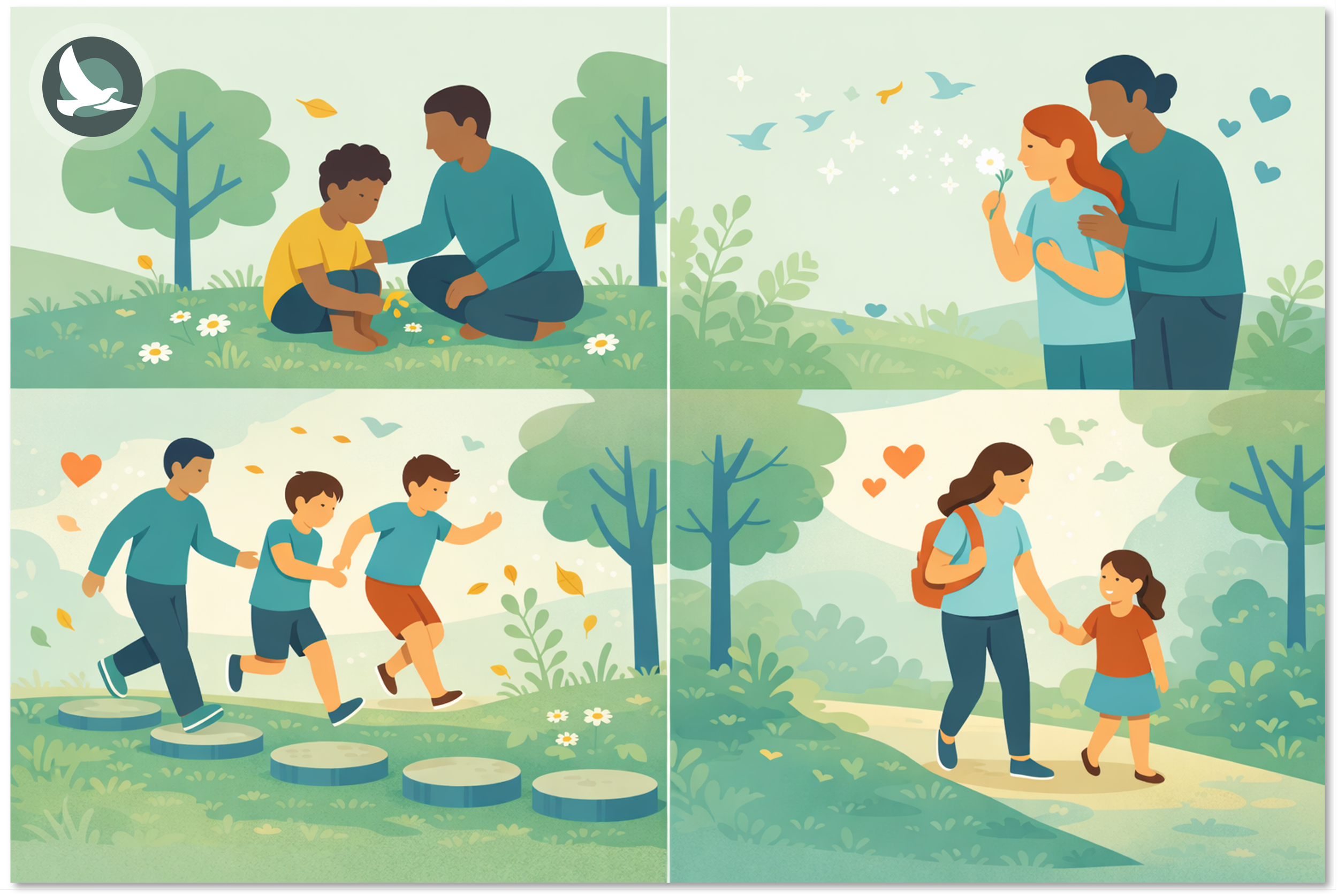
Simple outdoor activities to help children with anxiety, ADHD, and big emotions find calm as the seasons change.
Spring has a magical way of transforming kids, more sunlight means more energy, and sometimes more big feelings that arrive without warning.
If you're parenting a child with anxiety, ADHD, or a highly sensitive nervous system, this seasonal shift can bring extra wiggles, worries, and the occasional meltdown when it’s least convenient.
The good news is nature is a free emotional regulation toolkit, and you don't need fancy gear, a perfect plan, or even a backpack to use it. For me, local South Surrey / White Rock favourites include:
Crescent Park
Far West or East sides of White Rock beach
Sunnyside Acres Urban Forest
Kwomais Point Park to 1001 Steps
Duprez St. trail up Ruth Johnson Park to the playground (you’ll break a sweat on this one)
Research consistently shows that nature exposure improves mental health and well-being in children and adolescents (Lomax et al., 2024). Even 5–15 minutes outside can help kids—and exhausted parents—reset and recharge.
Below are practical, occasionally fun, and definitely non-complicated ways to turn outdoor time into calmer moments for your whole family.
Why the Outdoors Actually Helps Kids Regulate
When children feel overwhelmed, their bodies shift into "alarm mode"—that familiar fight, flight, or freeze response. Outdoor activities support emotional regulation in surprisingly powerful ways:
Reduces stress overload: Less sensory noise than indoor environments, plus more rhythmic natural input like bird sounds and breezes
Boosts attention and focus: Nature helps reduce mental fatigue (Liu et al., 2023)
Supports mood: Helpful for managing stress and depression symptoms alongside professional counseling (Lomax et al., 2024)
Encourages healthy movement: Physical activity supports executive function and emotional regulation (Carcelén-Fraile et al., 2025)
Fascinating research even suggests that greener living environments are associated with lower ADHD medication use at the population level—one of many clues that green space genuinely matters for attention and regulation (de Vries et al., 2022).
Your Quick Outdoor Regulation Menu
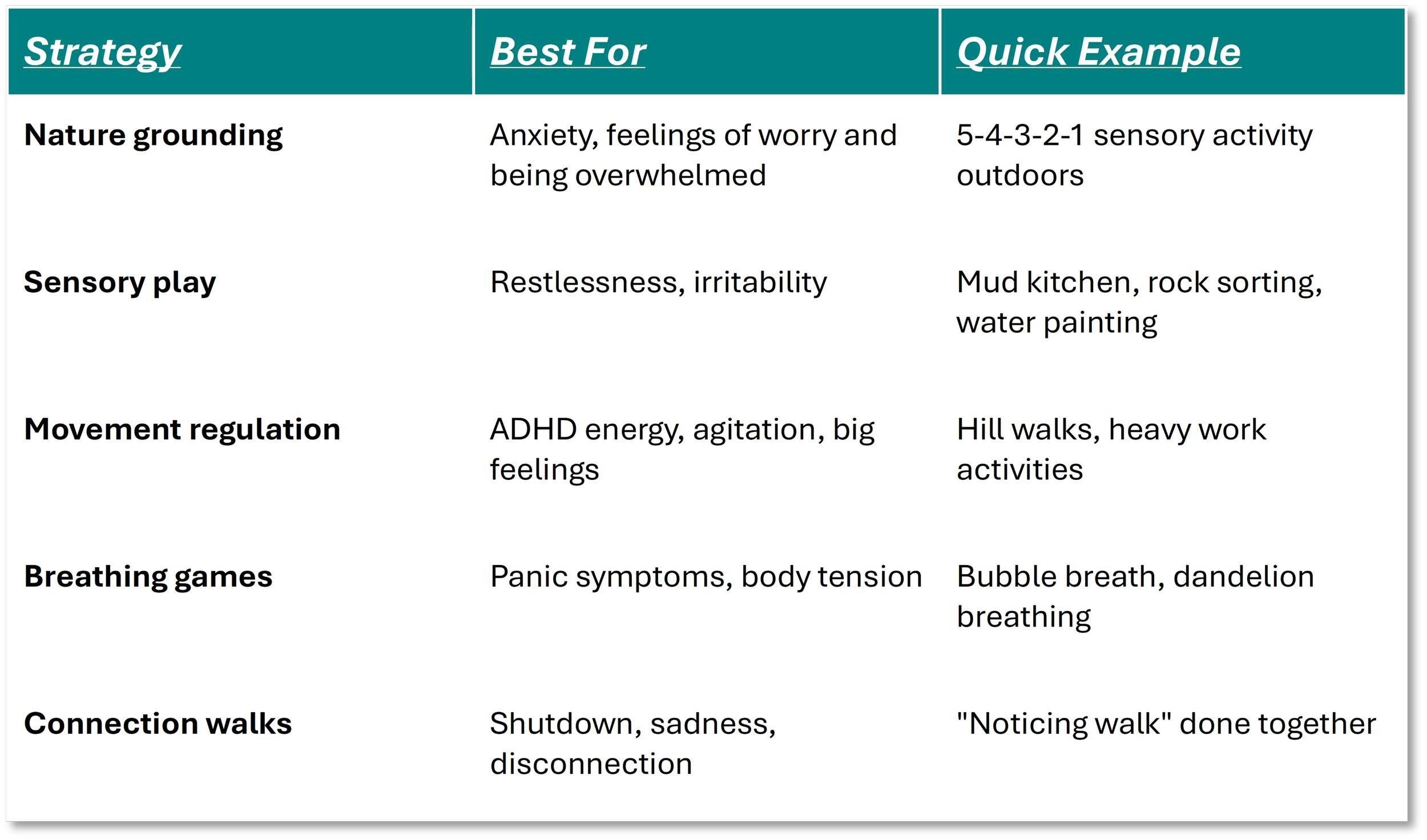
Not sure where to start? Pick one strategy that matches what your child needs:
Nature-Based Grounding for Anxious Minds
Grounding techniques help children "land" back in the present moment when worries race ahead or emotions feel overwhelming.
The 5-4-3-2-1 Nature Scan
This simple sensory activity works wonders. Ask your child to find:
5 things they can see (a pinecone, sidewalk crack, bird, cloud, dandelion)
4 things they can feel (bark texture, cool breeze, warm sunshine, grass)
3 things they can hear (rustling leaves, distant cars, their own footsteps)
2 things they can smell (fresh grass, rain, someone's BBQ down the street)
1 thing they can taste (okay, mint gum totally counts!)
Parent tip: Do this activity with your child. Co-regulation—where you regulate together—is incredibly powerful and teaches them what calm looks like.
Local Favourite: Try Crescent Park trails for a wide range things to find and don’t miss the pond!
Sensory Play That Actually Regulates
Sensory play isn't just for toddlers—many school-age kids and even teens regulate beautifully through tactile input, especially children with ADHD or sensory sensitivities.
Easy Outdoor Sensory Activities
Rock or stick sorting by size, color, texture, or shape
Chalk and water painting on sidewalks (watching it change and fade = surprisingly soothing)
Mud kitchen creation using old bowls, dirt, and water (instant therapy but get the laundry machine ready)
Nature treasure hunt: find something smooth, rough, tiny, bendy, or bright
Why this works: Predictable, hands-on sensory input calms the nervous system and reduces emotional intensity without requiring words or explanations.
Local Favourite: Try the far ends of White Rock Beach - water, sand, and carefully look under the rocks to see the crabs!
Movement Regulation (Because "Calm Down!" Rarely Works)
For many children, calm isn't something they can simply decide to feel—it's something their bodies earn through the right kind of movement.
Movement Activities That Help Regulate
Heavy work tasks: Carrying sticks, piling rocks, pushing a stroller, raking leaves
Hill walking: Steady uphill resistance helps discharge built-up stress
Animal movement: Bear crawls, crab walks, "sneaky fox steps"
Park circuit: Swing → climb → jump → slow walk (always end with slow movement)
Research shows that structured physical activity programs support executive function and emotional regulation in youth, including children with neurodevelopmental differences (Carcelén-Fraile et al., 2025).
Parent tip: Always end movement activities with a downshift—a slow walk, gentle stretch, or breathing exercise. This teaches the nervous system the complete "activate and then settle" cycle, which is crucial for long-term regulation.
Local Favourite: Try the trail from Duprez St. at the beach, up the hill to the Ruth Johnson Park playground, and yes you can do it!
Breathing Games Outside (No Boring Lung Lectures Required)
Deep breathing helps regulate the body's stress response, especially when anxiety starts climbing. The trick? Make it playful and engaging.
Four Breathing Games Kids Actually Enjoy
Bubble Breath: Slow inhale through the nose, long gentle exhale to create perfect bubbles
Dandelion Breath: "Blow softly enough that you don't scatter all the seeds at once"
Hot Cocoa Breath: Smell the delicious cocoa (inhale), cool it down slowly (exhale)
Pine Tree Breath: Inhale while raising arms up like branches, exhale while lowering them slowly
Nature-based mindfulness approaches show promise for stress reduction, improved attention, and better emotional regulation in children (PMC, 2024).
Local Favourite: Try Kwomais Point Park to 1001 Steps for some great views during this.
Connection Walks
The Noticing Walk
Walk together for just 5 minutes and each person shares:
One thing you notice right now
One thing you like about being outside
One thing you're curious about
This gentle activity supports emotional awareness without forcing heavy conversations your child might resist.
Create an Outdoor Calm Corner
Designate a simple "reset spot" in your yard or at a nearby park:
A bench, front step, or favorite tree
A small calm kit (smooth stone, fidget toy, note card listing two coping strategies)
For Teenagers
Teens often need different approaches, try:
Walking side-by-side instead of face-to-face conversations (less intense, more comfortable)
Music and movement: Headphones plus a loop around the block
Photography challenge: "Capture three signs of spring on your phone"
Local Favourite: Try Sunnyside Acres Urban Forest for a real forest experience, find some of the smaller tails
When Outdoor Tools Need Backup Support
Outdoor regulation strategies are genuinely helpful—and sometimes kids need additional support, especially when anxiety, depression, school avoidance, or frequent meltdowns start affecting daily life. That's exactly where professional counseling makes a meaningful difference.
Counseling can help by teaching personalized coping skills, supporting parent strategies, and addressing what's happening beneath the surface behaviors.
Let's Build a Regulation Plan That Works for Your Family
If your child struggles with big emotions, anxiety, attention challenges, or low mood, you absolutely don't have to figure this out alone. SOAR Counselling has a team specialized in supporting children and youth that can help you understand what your child's behaviour is communicating and build practical emotional regulation strategies that work at home, at school, and yes—even at the park.
To create a personalized plan for your child or teen, so spring can feel more like growth and less like chaos. Because every child deserves to enjoy the season of new beginnings without feeling overwhelmed by their own emotions.
How SOAR Counselling Supports Families
At SOAR Counselling, we specialize in meeting families exactly where they are. Our services include:
Youth counseling for anxiety, school stress, and emotional overwhelm
Parent support for burnout, co-parenting challenges, and life transitions
Family therapy to strengthen communication and emotional connections
Practical tools for improving home routines and family dynamics
We focus on providing a warm, judgment-free space where families can find clarity, develop coping strategies, and create a path forward — together.
Not sure where to start? Book a free consultation. We're happy to discuss your family's unique situation and explore the best options moving forward.
🧠 Outdoor Regulation: The Research
📚 Lomax, T., et al. (2024). Effect of nature on the mental health and well-being of children and adolescents (review). PMC. https://pmc.ncbi.nlm.nih.gov/articles/PMC11536187/
📚de Vries, S., et al. (2022). Residential green space associated with the use of ADHD medication (observational study). PMC. https://pmc.ncbi.nlm.nih.gov/articles/PMC9479333/
📚Liu, J., et al. (2023). The effect of exposure to nature on children's psychological well-being (review). ScienceDirect. https://www.sciencedirect.com/science/article/pii/S1618866723000171
📚Carcelén-Fraile, M. del C., et al. (2025). Effects of physical activity on executive function and emotional regulation in youths (systematic review/meta-analysis). PMC. https://pmc.ncbi.nlm.nih.gov/articles/PMC12524881/
📚PMC (2024). The Impact of Outdoor in Nature Mindfulness on the Mental Health. https://pmc.ncbi.nlm.nih.gov/articles/PMC10999151/
Want to learn more?
📞 Call us - (604) 398-5383
📧 Email us - contact@soarcounselling.ca
