
The Shift from School Structure to Summer Freedom: Helping Kids Reset and Find Purpose This Summer
Learn how a simple summer plan can help kids and teens reset after a busy school year
After a long school year it’s normal to need time to decompress, though your child may need more support if big feelings continue into summer - for more support book a free initial consultation
By June, many children and teens are running on empty. This article is meant to provide a helpful reminder that summer does not need to be overscheduled to be meaningful - a helpful summer is not necessarily a busy summer.
The end of the school year can bring big feelings and sudden changes in routine. Some kids finish the year feeling proud and excited, while others may feel emotionally tired, unmotivated, anxious, irritable, or disconnected. For children who have experienced stress, anxiety, ADHD, learning challenges, friendship struggles, or emotional regulation difficulties during the school year, summer may not immediately feel light or easy.
As parents, it can be tempting to respond by filling the calendar with camps, activities, sports, tutoring, trips, and plans. These can all be wonderful.
But summer does not need to become another performance season.
Instead, summer can be a reset — a chance to rebuild energy, confidence, connection, and purpose in a slower, more flexible way. The Italians have a great saying for this “Chi va piano, va sano e va lontano” which translates to “He who goes slowly, stays healthy and goes far”, which perfectly captures the philosophy of living sustainably, not as a lack of ambition, but as a reminder this will outlast rushing or overextending.
Why the end of school can feel so heavy
School asks kids and teens to manage early mornings, academic expectations, friendships, transitions, noise, screens, deadlines, social comparison, and the emotional work of “holding it together” all day.
By the time June arrives, I often see kids who are not just tired — they are exhausted.
You may notice:
Irritability or emotional outbursts
Less motivation
Disrupted sleep hygiene - More sleep or trouble sleeping
Avoidance of friends, activities, or responsibilities
Worry about report cards, next year, or social situations
A need for more downtime than usual
For some children, especially those with anxiety in children, ADHD in children, or emotional regulation challenges, the shift from school structure to summer freedom can also feel surprisingly hard. The routine disappears, expectations change, and kids may not know how to organize their time or emotions.
Summer does not need to be overscheduled to be meaningful
A helpful summer is not necessarily a busy summer.
Research on motivation suggests that young people thrive when three basic psychological needs are supported:
Autonomy – kids feel they have responsibility / choice
Competence – kids feel capable / progress
Relatedness – kids feel connected / belonging
In simple terms, kids need to feel they have some choice, that they are capable of doing things, and that they are connected to people who care about them. Ryan and Deci’s self-determination theory has shown how these needs support motivation, well-being, and healthy development. (Self Determination Theory)
This matters because many kids spend the school year being told where to go, what to finish, when to eat, how to behave, and what success looks like. Summer gives families a chance to return some healthy choice and ownership.
That does not mean letting kids do whatever they want. It means building a summer rhythm that includes both freedom and gentle structure.
What helps kids reset?
1. Rest Without Guilt
Some children need a quiet first week after school ends. That might mean sleeping in a little, reading, drawing, playing outside, watching a movie, or simply having fewer demands.
Rest is not laziness, it is recovery.
If your child seems burnt out, try not to rush them into “being productive” right away. A short reset period can help their nervous system settle before adding more activities.
2. Movement That Feels Enjoyable
Movement can support mood, sleep, stress, and emotional regulation. Reviews of research on physical activity and mental health in children and adolescents have found links between physical activity and areas such as anxiety, depression, self-esteem, and cognitive functioning, though the strength of evidence varies by outcome (sciencedirect.com).
The key is to make movement feel approachable.
This could include swimming at the pool, biking, walking the dog, playing basketball, joining a sports camp, hiking with family, paddleboarding, dance, yoga, or simply spending more time outdoors.
3. Responsibility That Builds Confidence
Summer is a great time to give kids small, meaningful responsibilities. Frame them as responsibilities as contribution, not chores as punishment.
This might be making lunch once a week, helping with a younger sibling, walking the dog, watering plants, organizing sports gear, helping plan a family outing, or choosing and preparing one dinner.
Age-appropriate responsibilities help children feel capable. Research on positive youth development also highlights the importance of initiative — giving young people opportunities to set goals, take action, and experience themselves as capable contributors (Youth Development at Illinois).
4. Connection and Belonging
Kids and teens need connection, even when they act like they do not. Baumeister and Leary’s well-known work on belonging describes strong, stable relationships as a fundamental human motivation (ResearchGate).
For summer, this could mean seeing friends, joining a camp, volunteering, attending a youth group, spending time with cousins, or having a predictable family night.
In South Surrey, White Rock, and Surrey, families can explore options such as recreation programs, local sports clubs, creative arts, community centre activities, youth spaces, and volunteer opportunities. For example, the City of Surrey lists volunteer opportunities that include training and growth, and youth leadership opportunities can include camp, sport, art, dance, drama, science, and themed programs (City of Surrey).
A simple summer plan template
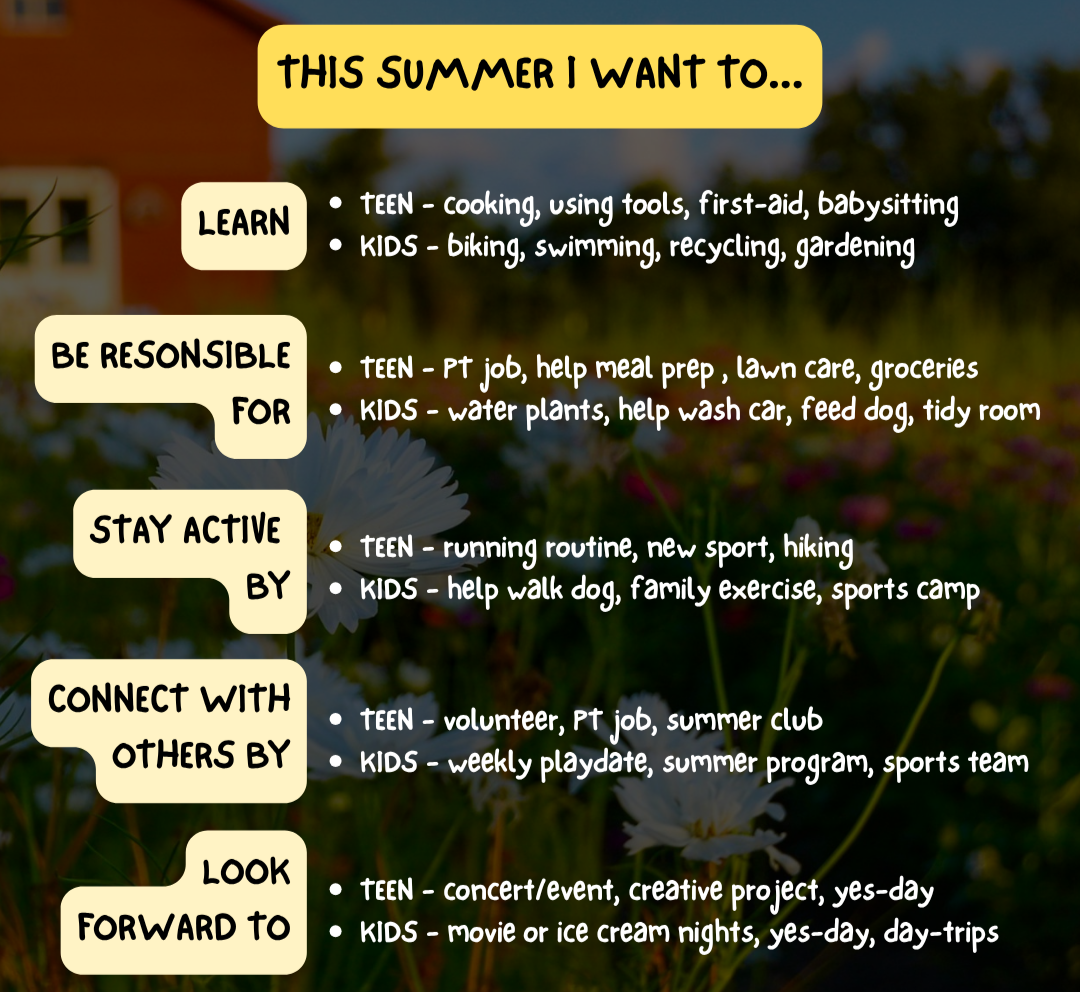
To help create a summer plan, you can use this conversation starter with your child or teen. Keep it light and let them help choose.
This summer, I want to:
1. Learn at least one thing:
Example for teens:
Learn basic cooking, using tools, take a first aid or babysitting course, build a resume, try coding or graphic design, learn photography, start a small business idea, practice budgeting, or take an intro course in leadership, engineering, business, or digital skills.
Examples for kids:
Learn to ride a bike, recycling, gardening, swim more confidently, make a simple meal, draw cartoons, care for a plant, read a new book series, build with LEGO or STEM kits, or learn a new sport skill like catching, dribbling, or skating.
2. Stay active in at least one way:
Examples for teens:
Join a gym or fitness class, start a running or walking routine, try tennis, basketball, soccer, swimming, hiking, yoga, paddleboarding, or sign up for a summer sports camp or training program,.
Examples for kids:
Ride bikes, go swimming, play at the park, walk the dog, join a day camp, play soccer or basketball with friends, go on family hikes, try dance, or have backyard obstacle-course challenges.
3. Connect with others by:
Examples for teens:
Plan a weekly friend meet-up, volunteer with a community program, join a youth leadership group, attend a teen drop-in program, work a part-time job with peers, join a sports team, or help organize a family or community event.
Examples for kids:
Have a weekly playdate, join a summer camp, visit cousins, attend library programs, invite a friend to the park, participate in a team sport, or create a family movie, game, or beach night tradition.
4. Take on at least one responsibility by:
Examples for teens:
Get a part-time job, volunteer regularly, help with younger siblings, cook one family meal each week, manage their own summer schedule, take on lawn care, help with grocery shopping, or plan and budget for a family activity.
Examples for kids:
Walk the dog, water plants, feed a pet, make their bed, help pack lunches, tidy toys or sports gear, set the table, help wash the car, or choose one household job they can “own” for the summer
5. Have at least one thing to look forward to:
Examples for teens:
Plan a beach day with friends, have a parent “yes-day”, attend a concert or local event, go on a day trip, complete a creative project, save money for something meaningful, take a short course, plan a volunteer milestone, or organize an end-of-summer activity.
Examples for kids:
Look forward to a picnic, have a parent “yes-day”, camp week, movie night, ice cream outing, family hike, trip to the pool, beach day, craft project, library challenge, or special one-on-one time with a parent or caregiver.
Local ideas for summer plans
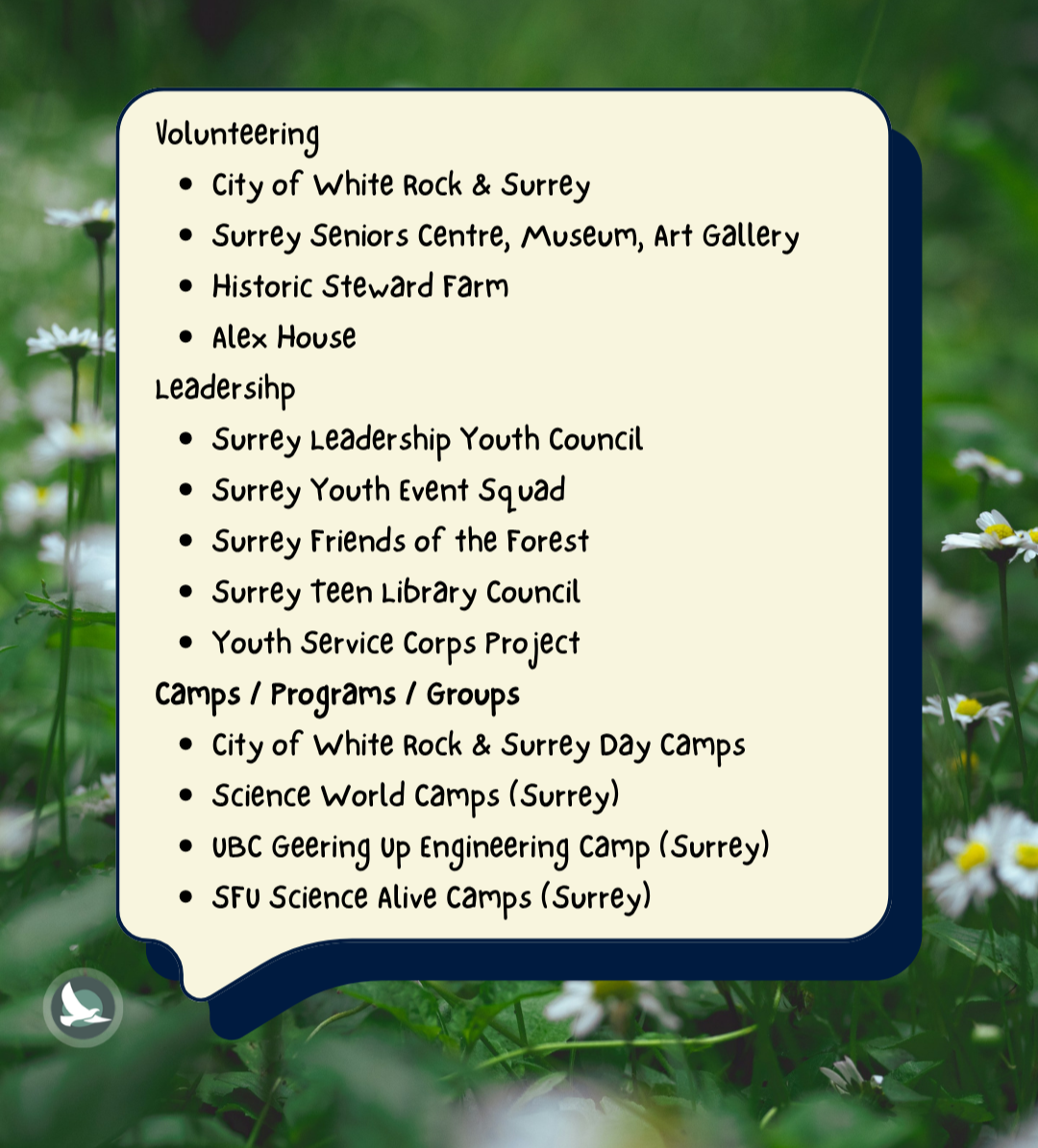
I’ve created a longer-list of local opportunities with links to explore:
Volunteering
· City of White Rock Volunteering
· Reading Buddies Mentor Program
· Historic Steward Farm Volunteering
Leadership
· Surrey’s Leadership Youth Council
· Surrey Youth Stewardship Squad
· Surrey Friends of the Forest
Camps / Programs / Groups
· White Rock Summer Kids Guide
· City of Surrey Day Camps Guide
· Science World Camps (Surrey)
· UBC Geering Up Engineering (South Surrey)
How SOAR can support when stress continues into summer
It is normal for kids to need some time to decompress, but if your child’s anxiety, low mood, irritability, emotional outbursts, sleep challenges, avoidance, or school-related burnout continue into the summer, they may need more support.
Child counselling and youth counselling can help children and teens understand their emotions, build new coping tools, strengthen confidence, and prepare for the next school year with more confidence and resilience.
At SOAR Counselling, we support children, youth, and families in White Rock, South Surrey, Surrey, surrounding communities, and across BC (virtually) with practical, compassionate mental health care. If your child is carrying stress, anxiety, emotional regulation challenges, or burnout into the summer, we would be honoured to support your family.
Want to learn more?
📞 Call us - (604) 398-5383
📧 Email us - contact@soarcounselling.ca
💬 Book your first session or free initial consultation online
🧠 The Shift from School Structure to Summer Freedom: The Research
📚 Ryan, R. M., & Deci, E. L. Self-determination theory and the role of autonomy, competence, and relatedness in motivation and well-being. (Self Determination Theory).
📚 Baumeister, R. F., & Leary, M. R. The need to belong: Desire for interpersonal attachments as a fundamental human motivation. (ResearchGate).
📚 Biddle, S. J. H., Ciaccioni, S., Thomas, G., & Vergeer, I. Physical activity and mental health in children and adolescents. (sciencedirect.com)
📚 Larson, R. W. Toward a psychology of positive youth development. (Youth Development at Illinois)
