
The Power of Sport: Building Confident, Resilient Kids — While Supporting Them Through Pressure and Stress
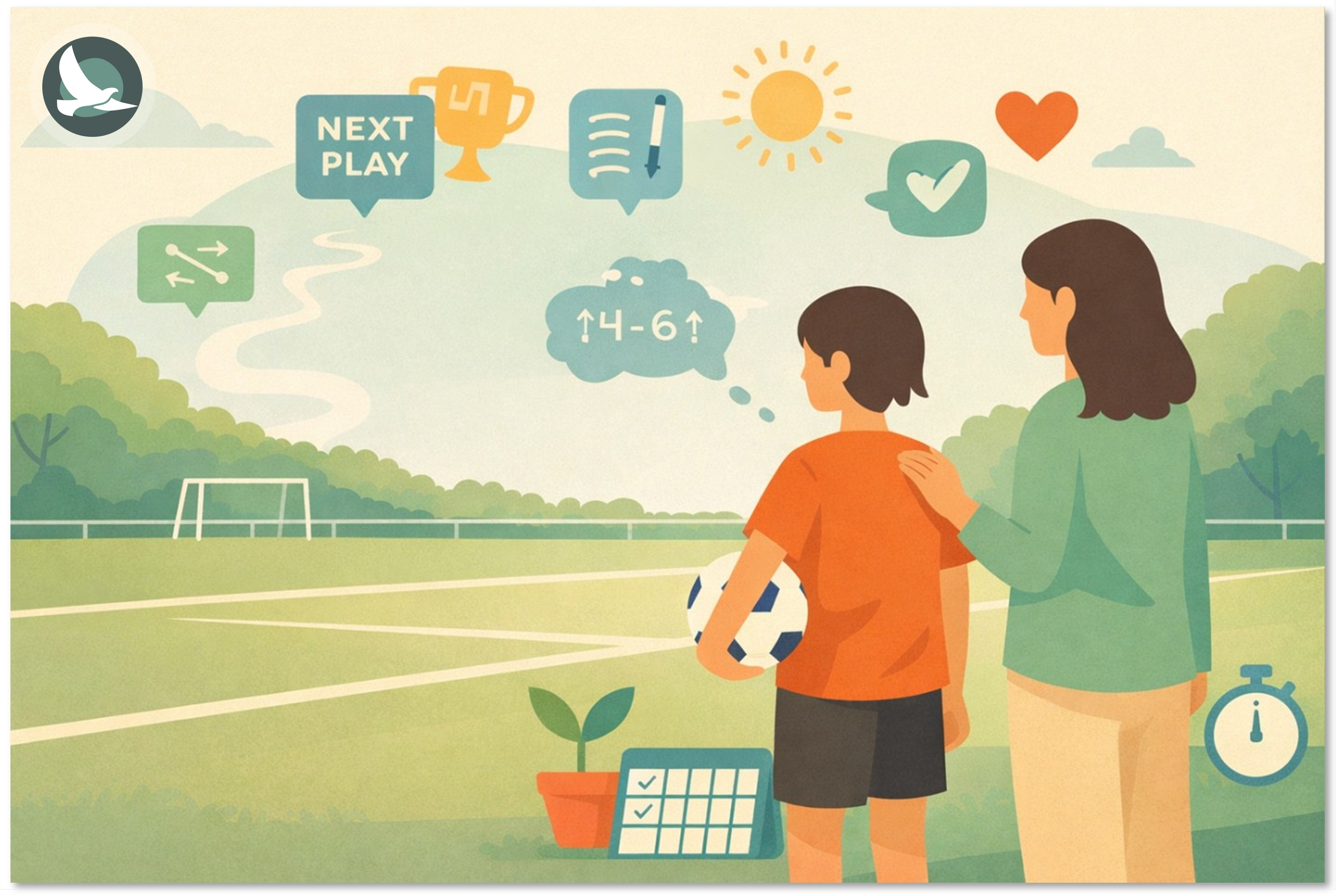
Support youth athletes with tools to manage anxiety, build confidence, and thrive in sports and life.
Spring across British Columbia often sees an increase in sports and activities for children and youth. Weeknights are filled with practices, weekends with games, and somewhere in between, kids are learning new skills, building friendships, and stepping into new challenges.
For many parents, it’s a joy to watch, but you might also notice something else.
Maybe your child gets nervous before a game, maybe they’re hard on themselves after mistakes, or maybe they’ve started putting a lot of pressure on themselves. If that’s happening, it doesn’t mean something is wrong. In many ways, it means your child is right where growth happens.
Why Sports Are So Powerful for Kids’ Development
Sports aren’t just about physical activity, they’re one of the most natural environments for kids to develop confidence, resilience, and emotional strength, not just for sports but also for throughout life.
In sport psychology, one simple way to understand this is through something called the “5 C’s”:
Commitment - Showing up and sticking with something
Confidence - Believing in your ability to improve
Concentration - Focusing in the moment
Control - Managing emotions under pressure
Communication - Connecting with others
Research continues to show that youth participation in sport is linked to improved mental health, including lower levels of anxiety in children and stronger emotional regulation (Biddle & Asare, 2011; Eime et al., 2013).
The Hidden Opportunity: Skills That Last Beyond Sport
One of the most valuable aspects of sport is how it prepares kids for life outside of it, when supported well, kids learn how to:
Handle pressure
Recover from mistakes
Stay focused under stress
Regulate emotions
These are the exact skills that translate to everyday life and that they can draw on over their lifetime, whether it be during exams, in university, at work, in relationships.
When Growth Starts to Feel Like Pressure
As kids get more invested in their sport, something shifts, they start to care more. This is great, but with it, it can also bring:
Pressure to perform
Fear of making mistakes
Comparisons to others
Internal expectations
This is often referred to as performance anxiety—and it’s a normal part of development.
Another helpful lens here is Self-Determination Theory, which explains that kids thrive when three needs are met:
Autonomy — feeling they have choice
Competence — feeling capable
Relatedness — feeling connected
When pressure and anxiety outweigh these needs, kids can shift from enjoying sport to feeling overwhelmed. If this is the case, the goal isn’t to remove the pressure, it’s to help your young athlete feel supported within it.
The Caregiver’s Role: Shaping the Experience
In communities around BC, including SOAR’s local area of South Surrey and White Rock, where youth sports are active and competitive, the parent’s role becomes even more important.
Kids don’t just learn from coaches—they learn from how parents respond. Helpful approaches include:
Keeping enjoyment at the centre
Focusing on effort over outcome
Normalizing mistakes
Modeling calm behaviour
This supports not just performance, but long-term mental health.
Approaches to Reduce Feelings of Pressure, Stress, and Anxiety in Sport
Next, I’ll cover some examples of what support might look like overall, before the game, in the moment, and after the game. These are proven approaches ready for a parent or young athlete to introduce regularly.
Overall Support
In general, it is most important to ensure our kids are setting the right foundation to reduce stress in sports, frameworks like the Biopsychosocial Model remind us that performance is never just physical—it’s shaped by:
The body (sleep, energy, health)
The mind (thoughts, emotions)
The environment (coaches, parents, teammates)
Continuous support for all three areas leads to more sustainable confidence and wellbeing.
Support Before the Game
The time leading up to a game is often where anxiety shows up the most. Instead of trying to eliminate it, we want to help kids relate to it differently. One approach from sport psychology is the Mindfulness-Acceptance-Commitment (MAC) model, which teaches athletes to:
Notice their thoughts and feelings
Accept them (rather than fight them)
Stay focused on what matters
In simple terms, you can feel nervous and still play well. A few practical ways to support this, that will help kids feel more grounded and prepared:
Creating a simple pre-game routine to build familiarity
Using visualization to mentally rehearse both success and mistakes
Naming emotions: “It makes sense you feel nervous—your body is getting ready”
Support in the Moment
During games, kids don’t need complex strategies; they need something simple to come back to. Many approaches here connect to what’s known as the Nine Mental Skills of Successful Athletes, which include focus, self-talk, and emotional control.
Some of the ones I would recommend for in the moment support include:
Managing Anxiety – Learn to accept anxiety as part of sport and know how to reduce it when it becomes too strong, try:
A slow breath (in for 4, out for 6)
Normalize nerves – “I’m feeling nervous because this matters to me”
Managing Emotions – Learn to accept strong emotions as part of the experience and use them to improve, try:
“Next play” rule, learn no replaying/dwelling, focus on the next play
Instead of reacting, practice channeling emotions into effort
Concentration – Learn to maintain focus and regain it when lost, try:
Instead of thinking about everything, focus on one-task
Use a trigger word – “focus” or “here”
These tools help shift kids support themselves and go from being overwhelmed to focused during sports.
Support After the Game
For many kids, the emotional impact of sport shows up after the game ends, which is where parents have the biggest influence.
Most importantly, connection comes first, sometimes the most powerful thing you can say is “I loved watching you play.”
If kids are open to it, a structure like the 2:1 reflection approach can help:
Two things that went well
One thing to improve
This aligns with performance psychology approaches that focus on:
Reinforcing confidence
Supporting growth
Avoiding all-or-nothing thinking
What Do High-Level Athletes Do?
Even elite athletes experience the same pressure kids do—they’ve just learned how to work with it.
For example, Simone Biles has spoken openly about:
Stepping back when overwhelmed
Using mental health support
Prioritizing psychological safety
Her approach reflects a shift in sport, where performance isn’t just about pushing through, it’s about understanding and supporting the mind. Similarly, many professional athletes use:
Visualization – Vividly imagine successful performance in different sport scenarios
Structured routines – Healthy fueling, physical and mental warm-up
These are the same tools we can begin teaching kids early.
When Extra Support Can Help
Sometimes, the balance shifts, you might notice your child is:
Becoming highly anxious
Losing confidence
Dreading their sport
When that happens, support can make a meaningful difference, sport-focused Counselling can help kids:
Manage performance anxiety
Build confidence
Strengthen emotional regulation
Reconnect with the joy of their sports
Supporting Your Young Athlete
If your child is experiencing stress, anxiety, or pressure related to sports, SOAR Counselling offers support tailored to youth and teen athletes.
Final Thought
Sports are one of the best environments for kids to grow because of what they learn along the way and when we support them through the pressure that comes with it we’re helping them build skills that last far beyond the field.
🧠 Power of Sport: The Research
📚 Biddle, S. J. H., & Asare, M. (2011). Physical activity and mental health in children and adolescents.
📚 Eime, R. M., et al. (2013). The psychological and social benefits of participation in sport.
📚 Gardner, F. L., & Moore, Z. E. (2007). The Psychology of Enhancing Human Performance (MAC approach)
📚 Gould, D., & Maynard, I. (2009). Psychological preparation for sport performance.
📚 Deci, E. L., & Ryan, R. M. (2000). Self-Determination Theory and intrinsic motivation.
Want to learn more?
📞 Call us - (604) 398-5383
📧 Email us - contact@soarcounselling.ca
